

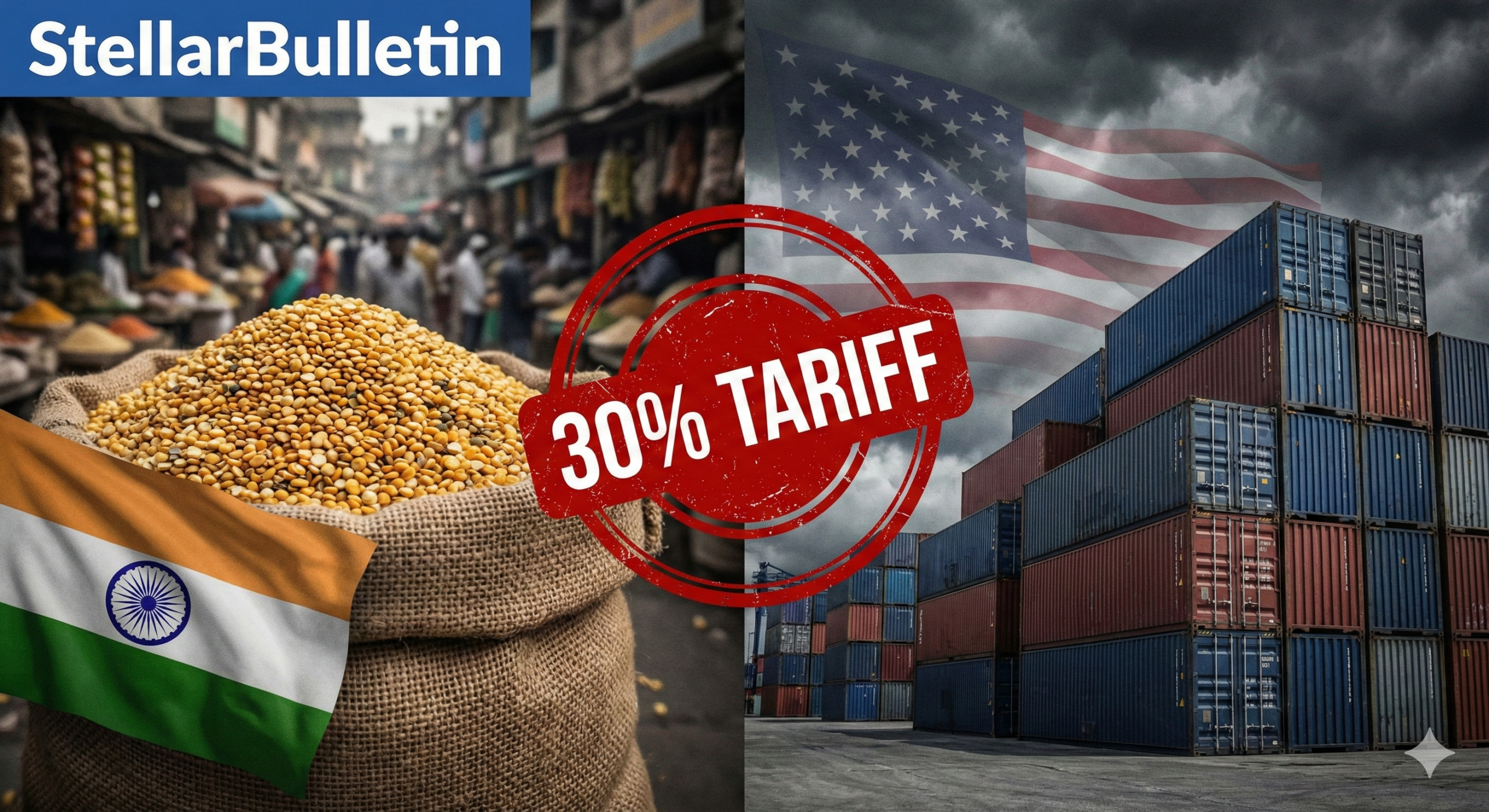




The simmering tensions underlying the strategic partnership between the United States and India have burst into the open once again this January 2026, centered on an unlikely geopolitical flashpoint: lentils. A significant 30% import duty imposed by New Delhi on specific American agricultural products in late 2025 has become a primary target for U.S. lawmakers, thrusting the India-US pulse trade dispute back to the forefront of bilateral relations under the updated Trump administration trade agenda.
While the tariffs were implemented months ago, fresh urgency emerged this week after key U.S. Senators representing agricultural states formally petitioned President Donald Trump. Their demand is clear: pressure India to rescind the duties that are crippling American pulse farmers, or face reciprocal consequences. This brewing conflict highlights the fragile nature of trade ties between the world’s two largest democracies, even as their defense and technology cooperation deepens.
The “Silent Retaliation” of November 2025
To understand the current fervor, one must look back to late last year. On October 30, 2025, India’s Department of Revenue issued a notification that caught many market observers by surprise. Effective November 1, a 30% customs duty was slapped on imports of yellow peas originating from the United States. While often categorized broadly under pulses and lentils in media reports, this specific targeting of yellow peas was strategic.
Trade analysts immediately characterized the move as a “silent retaliation.” Unlike previous trade skirmishes marked by loud political rhetoric, New Delhi implemented this measure with minimal fanfare. It was widely viewed as a direct counter-measure to punitive tariffs—reportedly ranging up to 50%—that the U.S. had imposed earlier on a select basket of Indian goods, linked to disputes over market access and India’s energy procurement policies.
By keeping the implementation low-key, India likely sought to establish leverage without immediately causing a diplomatic rupture. However, the economic reality of the India-US pulse trade dispute has now caught up with the political maneuvering, forcing the issue onto the desk of the U.S. President. The quiet nature of the initial rollout has given way to vocal opposition, as the economic pain points begin to manifest in tangible losses for producers across the ocean.
American Farmers Feel the Pinch
The impact of the 30% duty has been disproportionately felt in the American Midwest and Northern Plains. India is the globally dominant consumer of pulses, and losing access to that market is devastating for exporters. The duties make American produce uncompetitive compared to supplies from Canada, Australia, or Russia, which do not face the same retaliatory tariff walls.
Leading the current charge against the tariffs are U.S. Senators Kevin Cramer (R-ND) and Steve Daines (R-MT). In a strongly worded letter sent to President Trump on January 16, 2026, the Senators argued that American farmers are becoming collateral damage in broader trade wars. They highlighted that Montana and North Dakota are the premier producers of high-quality pulses reliant on export markets.
The core argument from the U.S. side centers on asymmetry. American legislators and trade representatives frequently point out the stark disparity in agricultural protectionism. While the average U.S. agricultural tariff hovers around 5%, India’s average currently sits near 39%. The Senators termed the situation “unfair” and an “uneven playing field,” urging the administration to prioritize the resolution of this India-US pulse trade dispute in virtually any upcoming high-level dialogue.
For American farmers already dealing with fluctuating global commodity prices and input costs, the Indian tariff is a severe blow to profitability, effectively shutting a multi-million dollar export avenue. The pulse industry in the U.S. relies heavily on export markets to clear inventory, and India has historically been the “buyer of last resort” due to its massive consumption volumes. Without this outlet, silos in North Dakota are staying full, and prices are being depressed locally.
The Indian Perspective: Inflation vs. Protection
From New Delhi’s vantage point, the tariff is a complex instrument serving dual purposes: diplomatic leverage and domestic protection.
Domestically, the Indian government is always walking a tightrope regarding pulses. Pulses (dal) are the primary source of protein for India’s vast vegetarian population. Ensuring affordability is a political necessity. Typically, when domestic production falls short due to erratic monsoons, India lowers import duties to flood the market and cool prices. Conversely, when domestic harvest is bountiful, duties are raised to protect Indian farmers from cheap imports crashing local prices.
The current 30% duty on U.S. pulses is framed within the government’s Atmanirbhar Bharat (Self-Reliant India) initiative, aimed at incentivizing domestic agriculture and reducing reliance on foreign food sources. Indian farmer lobbies generally support such measures, arguing they need shielding from highly subsidized Western agriculture. They argue that allowing U.S. pulses to enter duty-free would undercut the Minimum Support Price (MSP) guaranteed to Indian farmers, potentially leading to agrarian distress in states like Madhya Pradesh and Maharashtra.
However, there is a significant downside risk for India. If domestic supply tightens in the coming months, this high tariff barrier on a major supplier like the U.S. could exacerbate food inflation. A sharp rise in the price of dal is historically politically damaging for ruling governments in India. Therefore, New Delhi’s resolve on the India-US pulse trade dispute will likely be tested by domestic inflation metrics as much as U.S. pressure. If the upcoming rabi harvest is suboptimal, the government may be forced to rethink its protective stance, regardless of the diplomatic signalling intended.
The Geopolitical Chessboard
This trade dispute cannot be viewed in isolation; it is part of the broader, often transactional approach to foreign policy characterizing the executive leadership in both nations. While the U.S. and India are aligning closely to counter China’s influence in the Indo-Pacific, trade remains a persistent irritant.
The revival of this issue in January 2026 suggests that the U.S. administration is preparing to engage India on a wide array of economic issues. The 30% pulse duty is now a key bargaining chip. It is highly probable that India anticipates using the removal of this duty as a concession in exchange for U.S. flexibility on other matters, such as restoring India’s status under the Generalized System of Preferences (GSP) or easing visa restrictions for Indian tech workers.
The GSP program, which allowed duty-free entry for thousands of Indian products into the U.S., was revoked during the previous Trump term and has remained a sticking point. Analysts believe India is using the pulse tariffs to force the U.S. back to the negotiating table regarding GSP restoration.
The India-US pulse trade dispute is a litmus test for how the two nations manage friction. Will they compartmentalize trade disagreements while advancing defense ties, or will economic nationalism poison the broader well of strategic partnership? The timing is critical, as both nations are navigating a volatile global economy where supply chain resilience is paramount. By erecting barriers, they risk contradicting the very “friend-shoring” rhetoric they have championed in other forums like the Quad.
Future Outlook: Deal or Escalation?
As we move further into 2026, two primary scenarios are likely to emerge regarding the India-US pulse trade dispute.
Scenario A: The “Mini-Deal” Settlement
Given the transactional nature of current U.S. trade policy, a negotiated settlement is plausible. A “mini-trade deal” could be crafted where India agrees to lower or remove the 30% pulse tariffs for a specific quota of imports. In exchange, the U.S. might drop its retaliatory levies on Indian steel or aluminum, or perhaps offer a limited reinstatement of GSP benefits for specific sectors. This would allow leaders in both Washington and New Delhi to claim a victory for their respective domestic constituencies—Trump for American farmers, and India for its exporters.
Scenario B: Cycle of Escalation
If talks stall, the situation could deteriorate quickly. The U.S. administration, pressured by the strong farm lobby, could respond to the Senators’ demands by launching Section 301 investigations into Indian trade practices. This could lead to fresh tariffs on high-value Indian exports like textiles, pharmaceuticals, or jewelry—sectors that employ millions in India. India, in turn, might seek to permanently diversify its pulse sourcing away from the U.S., solidifying long-term agricultural trade ties with nations like Australia, Russia, or African partners like Mozambique and Tanzania. Such a move would result in a permanent loss of market share for U.S. growers, resolving the India-US pulse trade dispute not through agreement, but through decoupling.
Conclusion
For now, the humble lentil remains at the center of a high-stakes geopolitical power play, symbolizing the difficult reality of aligning the economic interests of two fiercely independent nations. As the Senators’ letter lands on the President’s desk, the clock begins ticking on a resolution. Whether this leads to a handshake or a trade war will depend on how skillfully negotiators can balance the needs of North Dakota’s farmers with the complexities of India’s domestic food security. The India-US pulse trade dispute is no longer just about agriculture; it is about the terms of engagement for the future of the Indo-US economic corridor.